Linggo, Setyembre 25, 2011
hha.. Waleyy langss !!
hayy, pasok na naman bukas .. magche-check na ng papers sa pre-lim sa earth science.. haii,, kakaba .. so much..!! jiji !!? Yun lamangss sa ngayon !!!

Huwebes, Setyembre 15, 2011
Martes, Setyembre 13, 2011
news! news ! news...
-currently watching news 'bout SHAMCEY SUPSUP..haha..galing!! kabilib siya.. hihi..share lang !!!
Biyernes, Setyembre 9, 2011
.It's Saberday..haha
ibang gawain na naman ngayong araw na ito.. linis linis na naman sa house..hayy,katamad..hhaha,,joke lang,, bukas na lang ulit..BYEEE...!!!
Huwebes, Setyembre 8, 2011
..Intrams !!
..wooohoooo..!! ang saya kanina ..uber uber ..! iba ang pressure ,..grabeee!!! sana manalo ang GREEN ARCHERS.. ilabeet... L-E-T'-S G-O..THAT'S THE WAY WE SPELL LET'S GO,LET'S GO ARCHERS LET'S GOOOOO !!! NO BLUE, NO YELLOW, NO RED..JUST GREEN !!.. GO GREEN !!!!!! HHAHA...
peace...
peace...
Martes, Agosto 30, 2011
open Office
MS POWERPOINT - impress (.odp.)
MS ACCESS - base (.odb.)
MS EXCEL - calc (.ods.)
MS WORD - writer (.odt.)
sir,pasensya po ngayon ko lang po nagawa kasi po ngayon lang po kami nagka-internet eh..sana po maintindihan niyo ..salamat po !!!!
MS ACCESS - base (.odb.)
MS EXCEL - calc (.ods.)
MS WORD - writer (.odt.)
sir,pasensya po ngayon ko lang po nagawa kasi po ngayon lang po kami nagka-internet eh..sana po maintindihan niyo ..salamat po !!!!
Lunes, Agosto 22, 2011
toot-toot-toot !!!! :)
ahm..the only commodity on earth that does not worn out with use is KNOWLEDGE ....!!!
...hihihi..hayy.nakakakaba mag-title defense tomorrow ,.,.sobrAaAaaaaa ))))))
...hihihi..hayy.nakakakaba mag-title defense tomorrow ,.,.sobrAaAaaaaa ))))))
Linggo, Agosto 21, 2011
Biyernes, Agosto 12, 2011
.trip only.
..Huh,,gosh..very much busy this week..have to review for the periodical test on August 18 and 19..hope i'll get high score and pass the exam in major and minor subjects.. .that's all i can say.... soooooooow NERVOUS....
Lunes, Agosto 8, 2011
PC CARE AND SAFETY PROCEDURES FOR USERS
Computers are sensitive equipment that can be easily damaged by different factors and can cause health hazards to users if not treated properly. Computers should be placed in a cool and dry place, a place with an electric fan or air conditioning. To avoid accidents, all cables and connectors must be tied together. Never eat in front of a computer because food bits attract ants and cockroaches that can cause malfunction and spilled drink might cause short circuit. To regulate electricity, always use the AVR and always turn off computers during lightning. Be sure not to drop computer components because any damage may cause malfunction. Clean computers by using soft cloth to avoid scratches. Always scan for computer viruses to avoid damaging the files and causing software malfunction. Personal computers are said to be "user-friendly" but this doesn't mean using them does not have health risks. We use always have a good working habit especially when using the computers. Take short rests and vision breaks when staring at the monitor for long periods.Pains in the head, neck, shoulder and back due to prolonged use of of computers may also be experienced by the user so make sure to use a proper workstation.
Huwebes, Hulyo 28, 2011
different types of computers
A computer is one of the most brilliant inventions of mankind. Thanks to the computer technology, we were able to achieve an efficient storage and processing of data; we could rest our brains by employing computer memory capacities for storage of the information. Owing to computers, we have been able speed up daily work, carry out critical transactions and achieve accuracy and precision in work output. The computers of the earlier years were of the size of a large room and were required to consume huge amounts of electric power. However, with the advancing technology, computers have shrunk to the size of a small watch. Depending on the processing powers and sizes of computers, they have been classified under various types. Let us look at the classification of computers.
Different types of Computers
Based on the operational principle of computers, they are categorized as analog computers and hybrid computers.
Analog Computers: These are almost extinct today. These are different from a digital computer because an analog computer can perform several mathematical operations simultaneously. It uses continuous variables for mathematical operations and utilizes mechanical or electrical energy.
Hybrid Computers: These computers are a combination of both digital and analog computers. In this type of computers, the digital segments perform process control by conversion of analog signals to digital ones.
Following are some of the other important types of computers.
Mainframe Computers: Large organizations use mainframes for highly critical applications such as bulk data processing and ERP. Most of the mainframe computers have the capacities to host multiple operating systems and operate as a number of virtual machines and can thus substitute for several small servers.
Microcomputers: A computer with a microprocessor and its central processing unit is known as a microcomputer. They do not occupy space as much as mainframes. When supplemented with a keyboard and a mouse, microcomputers can be called as personal computers. A monitor, a keyboard and other similar input output devices, computer memory in the form of RAM and a power supply unit come packaged in a microcomputer. These computers can fit on desks or tables and serve as the best choices for single-user tasks.
Personal computers come in a variety of forms such as desktops, laptops and personal digital assistants. Let us look at each of these types of computers.
Desktops: A desktop is intended to be used on a single location. The spare parts of a desktop computer are readily available at relative lower costs. Power consumption is not as critical as that in laptops. Desktops are widely popular for daily use in workplaces and households.
Laptops: Similar in operation to desktops, laptop computers are miniaturized and optimized for mobile use. Laptops run on a single battery or an external adapter that charges the computer batteries. They are enabled with an inbuilt keyboard, touch pad acting as a mouse and a liquid crystal display. Its portability and capacity to operate on battery power have served as a boon for mobile users.
Personal Digital Assistants (PDAs): It is a handheld computer and popularly known as a palmtop. It has a touch screen and a memory card for storage of data. PDAs can also be effectively used as portable audio players, web browsers and smart phones. Most of them can access the Internet by means of Bluetooth or Wi-Fi communication.
Minicomputers: In terms of size and processing capacity, minicomputers lie in between mainframes and microcomputers. Minicomputers are also called mid-range systems or workstations. The term began to be popularly used in the 1960s to refer to relatively smaller third generation computers. They took up the space that would be needed for a refrigerator or two and used transistor and core memory technologies. The 12-bit PDP-8 minicomputer of the Digital Equipment Corporation was the first successful minicomputer.
Supercomputers: The highly calculation-intensive tasks can be effectively performed by means of supercomputers. Quantum physics, mechanics, weather forecasting, molecular theory are best studied by means of supercomputers. Their ability of parallel processing and their well-designed memory hierarchy give the supercomputers, large transaction processing powers.
Wearable Computers: A record-setting step in the evolution of computers was the creation of wearable computers. These computers can be worn on the body and are often used in the study of behavior modeling and human health. Military and health professionals have incorporated wearable computers into their daily routine, as a part of such studies. When the users’ hands and sensory organs are engaged in other activities, wearable computers are of great help in tracking human actions. Wearable computers are consistently in operation as they do not have to be turned on and off and are constantly interacting with the user.
These were some of the different types of computers available today. Looking at the rate of the advancement in technology, we can definitely look forward to many more types of computers in the near future.
Different types of Computers
Based on the operational principle of computers, they are categorized as analog computers and hybrid computers.
Analog Computers: These are almost extinct today. These are different from a digital computer because an analog computer can perform several mathematical operations simultaneously. It uses continuous variables for mathematical operations and utilizes mechanical or electrical energy.
Hybrid Computers: These computers are a combination of both digital and analog computers. In this type of computers, the digital segments perform process control by conversion of analog signals to digital ones.
Following are some of the other important types of computers.
Mainframe Computers: Large organizations use mainframes for highly critical applications such as bulk data processing and ERP. Most of the mainframe computers have the capacities to host multiple operating systems and operate as a number of virtual machines and can thus substitute for several small servers.
Microcomputers: A computer with a microprocessor and its central processing unit is known as a microcomputer. They do not occupy space as much as mainframes. When supplemented with a keyboard and a mouse, microcomputers can be called as personal computers. A monitor, a keyboard and other similar input output devices, computer memory in the form of RAM and a power supply unit come packaged in a microcomputer. These computers can fit on desks or tables and serve as the best choices for single-user tasks.
Personal computers come in a variety of forms such as desktops, laptops and personal digital assistants. Let us look at each of these types of computers.
Desktops: A desktop is intended to be used on a single location. The spare parts of a desktop computer are readily available at relative lower costs. Power consumption is not as critical as that in laptops. Desktops are widely popular for daily use in workplaces and households.
Laptops: Similar in operation to desktops, laptop computers are miniaturized and optimized for mobile use. Laptops run on a single battery or an external adapter that charges the computer batteries. They are enabled with an inbuilt keyboard, touch pad acting as a mouse and a liquid crystal display. Its portability and capacity to operate on battery power have served as a boon for mobile users.
Personal Digital Assistants (PDAs): It is a handheld computer and popularly known as a palmtop. It has a touch screen and a memory card for storage of data. PDAs can also be effectively used as portable audio players, web browsers and smart phones. Most of them can access the Internet by means of Bluetooth or Wi-Fi communication.
Minicomputers: In terms of size and processing capacity, minicomputers lie in between mainframes and microcomputers. Minicomputers are also called mid-range systems or workstations. The term began to be popularly used in the 1960s to refer to relatively smaller third generation computers. They took up the space that would be needed for a refrigerator or two and used transistor and core memory technologies. The 12-bit PDP-8 minicomputer of the Digital Equipment Corporation was the first successful minicomputer.
Supercomputers: The highly calculation-intensive tasks can be effectively performed by means of supercomputers. Quantum physics, mechanics, weather forecasting, molecular theory are best studied by means of supercomputers. Their ability of parallel processing and their well-designed memory hierarchy give the supercomputers, large transaction processing powers.
Wearable Computers: A record-setting step in the evolution of computers was the creation of wearable computers. These computers can be worn on the body and are often used in the study of behavior modeling and human health. Military and health professionals have incorporated wearable computers into their daily routine, as a part of such studies. When the users’ hands and sensory organs are engaged in other activities, wearable computers are of great help in tracking human actions. Wearable computers are consistently in operation as they do not have to be turned on and off and are constantly interacting with the user.
These were some of the different types of computers available today. Looking at the rate of the advancement in technology, we can definitely look forward to many more types of computers in the near future.
history of computers
Abacus
The earliest known device to record computations was the abacus. It dates back to ancient times and was invented by the Chinese. Ten beads were strung onto wires attached to a frame. Addition and subtraction were read from the final positions of the beads. It was considered the first manual tool used in calculating answers to problems that provided information and in a primitive way storing the results.
Mechanical ClockDuring the Middle Ages the first closed system in terms of calculating information was invented by use of a mechanical clock. The parts of the clock calculated the time of day. The time was displayed through the position of two hands on its face. The inventor pre-programmed the clock instructions through the manner in which the pull of the weights and the swing of the pendulum with the movement of the gears established the position of the hands on the clock face.
MathematicsJohn Napier (Scotsman mid 1600s) discovered logarithms. He devised a system where he put the logarithms on a set of ivory rods called "Napier’s Bones". By sliding the numbers up and down he invented a very primitive slide rule. Robert Bissaker perfected the system by placing numbers on sliding pieces of wood rather than ivory.
Blaise Pascal(1642) developed the first real calculator. Addition and subtraction were carried out by using a series of very light rotating wheels. His system is still used today in car odometers which track a car’s mileage.
Gottfried van Leibnitz(German mathematician) In 1690 Leibnitz developed a machine that could add, subtract, multiply, divide, and calculate square roots. The instructions were programmed into the machine. Programming was accomplished through the use of gears. The drawback to this machine was that the instructions could not be changed without changing the whole machine.
Joseph Jacquard(early 1800’s) Jacquard developed a loom controlled by punched cards. The cards were made of cardboard which were programmed with instructions. Each card represented a loop, and the machine read the cards as they were passed over a series of rods. The loom was the early ancestor of the IBM punched card.
Charles Babbage(1812) Babbage was a genius of a man who saw few of his inventions actually built. He designed and built a model of what was called the difference engine. This invention was designed to perform calculations without human intervention. The ultimate goal of the machine was to have the machine calculate logarithm tables and print the results. Babbage was so far ahead of the times that the technology was not in place to manufacture the parts for his machine so he was only able to build a small model. In 1833, Babbage then designed the analytic engine. This machine had many of the same parts that could be found in modern day computers. It had an arthmetic unit which performed calculations. Another part of the computer was called the "store" which stored intermediate and final results and instructions. This was completed for each stage of calculation. It was to get its instructions from punched cards and worked through mechanical means. The machine would be able to perform any calculation. Before the machine could be made Babbage died. His son built a small model of the work that still exists today. Babbage became known as the father of the modern day computers.
Dr. Herman Hollerith(late 1800 statistician) Hollerith used the punched card method to process data gathered in the census. The previous census had taken seven years to complete because of the large amount of data collected that needed to be processed. By developing the Hollerith code and a series of machines which could store census data on cards, he was able to accomplish the accounting of the census in two and a half years with an additional two million pieces of data added. His code was able to sort the data according to the needs of the United States Government. He was known for developing the first computer cardand accomplishing the largest data processing endeavor undertaken at the time. Hollerith set up the Tabulating Machine Company which manufactured and marketed punched cards and equipment to the railroads. The railroads used the equipment to tabulate freight schedules. In 1911, the Tabulating Machine Company merged with other companies to form the International Business Machine Corporation (IBM).
William Burroughs
(late 1890’s) designed the mechanical adding machine. The machine operated by way of a crank and was key driven. The Burroughs Adding Machine Company was to become one of the giants of the computer industry. His machine could record, calculate, and summarize. Today, Burroughs has merged with UNISYS which builds computers.
The Years from 1900-1940During the next forty years, more of the adding, calculating, and tabulating machines were developed. Eventually the machines evolved to a point where they could multiply, interpret the alphabetic data, recordkeeping, and other accounting functions. They were called accounting machines.
Howard Aiken(1944) The Mark I ,through a collaboration with Harvard University, IBM, and the U.S. War Department, was developed to handle a large amount of number crunching. The complex equation solving that was needed to map logistics in the military was the driving force behind this project. ( The United States was at war with Germany.) The Mark I was the first automatic calculator. It was not electronic, but did use electromagnetic relays with mechanical counters. It was said that when it ran the clicking sound was unbearable. Paper tape with hole punched in it provided the instruction sets, and the output was returned through holes punched in cards.
J. Presper Eckert and John W. Mauchly(ENIAC, 1946 University of Pennsylvania) The ENIAC (Electronic Numerical Integrator and Calculator) was an electronic computer sponsored by the war department. It was classified because of war purposes. The ENIAC was so large that it took up a room ten feet high by about ten feet wide and several hundred feet in length. It could perform multiplication in the 3/1000 of a second range. There were 18,000 vacuum tubes in the machine and instructions had to be fed into the machine by way of switches because there was no internal memory within the machine.
Jon Von Neumann(late 1940’s) devised a way to encode instructions and data in the same language. This paved the way for computer instructions to be stored in the computer itself. He was the forced behind the development of the first stored-program computer.
A Race Between the EDVAC and the EDSAC
Two groups of individuals were working at the same time to develop the first stored-program computer. In the United States, at the University of Pennsylvania the EDVAC (Electronic Discrete Variable Automatic Computer) was being worked on. In England at Cambridge, the EDSAC (Electronic Delay Storage Automatic Computer) was also being developed. The EDSAC won the race as the first stored-program computer beating the United States’ EDVAC by two months. The EDSAC performed computations in the three millisecond range. It performed arithmetic and logical operations without human intervention. The key to the success was in the stored instructions which it depended upon solely for its operation. This machine marked the beginning of the computer age.
First Generation (1951-1958)
John W. Mauchly and J. Presper Eckert(1951) The first generation of computers started with the UNIVAC I (Universal Automatic Computer) built by Mauchly and Eckert. It was sold to the U.S. Census Bureau. This machine was dedicated to business data processing and not military or scientific purposes.
Characteristics of First Generation ComputersUse of vacuum tubes in electronic circuits: These tubes controlled internal operations and were huge. As a consequence the machines were large.
Magnetic drumas primary internal-storage medium: Electric currents passed through wires which magnetized the core to represent on and off states
Limited main-storage capacity:Slow input/output, punched-card-oriented: Operators performed input and output operations through the use of punched cards.
Low level symbolic-language programming: The computer used machine language which was cumbersome and accomplished through long strings of numbers made up of Zeroes and Ones. In 1952, Dr. Grace Hopper (University of Pennsylvania) developed a symbolic language called mnemonics (instructions written with symbolic codes). Rather than writing instructions with Zeroes and Ones, the mnemonics were translated into binary code. Dr. Hopper developed the first set of programs or instructions to tell computers how to translate the mnemonics.
Heat and maintenance problems: Special air-conditioning and maintenance were required of the machines. The tubes gave off tremendous amounts of heat.
Applications: payroll processing and record keeping though still oriented toward scientific applications thatn business data processing.
Examples: IBM 650 UNIVAC I
Second Generation Computers (1959-1964)
Characteristics of Second Generation Computers
Use of transitors for internal operations: tiny solid state transitors replace vacuum tubes in computers. The heat problem was then minimized and computers could be made smaller and faster.
Magnetic core as primary internal-storage medium: Electric currents pass through wires which magnetize the core to represent on and off states.Data in the cores can be found and retrieved for processing in a few millionths of a second.
Increased main-storage capacity: The internal or main storage was supplemented by use of magnetic tapes for external storage. These tapes substituted for punched cards or paper. Magnetic disks were also developed that stored information on circular tracks that looked like phonograph records. The disks provided direct or random access to records in a file.
Faster input/output; tape orientation: Devices could be connected directly to the computer and considered "on-line". This allowed for faster printing and detection and correction of errors.
High-level programming languages (COBOL,FORTRAN) : These languages resembled English. FORTRAN (FORmula TRANslator) was the first high-level language that was accepted widely. This language was used mostly for scientific applications. COBOL (Common Business-Oriented Language) was developed in 1961 for business data processing. Its main features include: file-processing, editing, and input/output capabilites.
Increased speed and reliability: Modular-hardware was developed through the design of electronic circuits. Complete modules called "breadboards" could be replaced if malfunctions occurred, or the machine "crashed". This decreased lost time and also new modules could be added for added features such as file-processing, editing , and input/output features.
Batch-oriented applications:billing, payroll processing, updating and inventory files: Batch processing allowed for collection of data over a period time and then one processed in one computer run. The results were then stored on magnetic tapes.
Examples:IBM 1401*(most popular business-oriented computer. Honeywell 200 CDC 1604
Third Generation Computers (1965-1970)
Characteristics of Third Generation Computers:Use of integrated circuits: The use of integrated circuits (Ics) replaced the transitors of the second-generation machines. The circuits are etched and printed and hundreds of electronic components could be put on silicon circuit chips less than one-eighth of an inch square.Magnetic core and solid-state main storage: Greater storage capacity was developed.
More flexibility with input/output; disk-oriented:
Smaller size and better performance and reliability: Advances in solid-state technology allowed for the design and building of smaller and faster computers. Breadboards could easily be replaced on the fly.
Extensive use of high-level programming languages: The software industry evolved during this time. Many users found that it was more cost effective to buy pre-programmed packages than to write the programs themselves. The programs from the second generation had to be rewritten since many of the programs were based on second generation architecture.
Emergence of minicomputers: The mini computers offered many of the same features as the mainframe computers only on a smaller scale. These machines filled the needs of the small business owner.
Remote processing and time-sharing through communication: Computers were then able to perform several operations at the same time. Remote terminals were developed to communicate with a central computer over a specific geographic location. Time sharing environments were established.
Availability of operating-systems(software) to control I/O and do tasks handled by human operators: Software was developed to take care of routine tasks required of the computer freed up the human operator.
Applications such as airline reservation systems, market forcasting, credit card billing: The applications also included inventory, control, and scheduling labor and materials. Multitasking was also accomplished. Both scientific and business applications could be run on the same machine.
Examples: IBM System/360 NCR 395 Burroughs B6500
Fourth Generation (1970-)
Characteristics of Fourth Generation Computers:Use of large scale integrated circuitsIncreased storage capacity and speed.
Modular design and compatibility between equipment
Special application programs
Versatility of input/ output devices
Increased use of minicomputers
Introduction of microprocessors and microcomputers
Applications: mathematical modeling and simulation, electronic funds transfer, computer-aided instruction and home computers. Internet Explosion.
- Control Data Corporation: STAR 100 computer which has a vector based design. Information is processed as vectors instead of numbers. This allows for faster speed when problems are processed in vector form. Charles A. Burrus develops the (LED) light-emitting diode. RCA develops (MOS) technology, a metal-oxide semiconductor for the making of integrated circuits, making them cheaper and faster to produce. The circuits can also be made smaller.
- Texas Instruments introduces the first pocket calculator the Pocketronic. It can add subtract, multiply and divide. It costs around $150.
- Odyssey developed by Magnavox(first video game).Intel develops the first 8-bit microprocessor chip the 8008. (Used in the Mark-8 personal mini-computer). Nolan Bushnell invents a video game with a liquid crystal screen. The toy is called Pong. Bushnell founds Atari.
- Using LSI (large scale integration) ten thousand components are placed on a chip of 1 square inch.
- Hewlett Packard introduces the programmable pocket calculator. David Ahl develops a microcomputer consisting of a video display, keyboard and central processing unit. D-RAM (dynamic random access becomes commercially available and will be used in the first personal computers.
- Edward Roberts introduces the first personal computer call the Altair 8800 in kit form. It has 256 bytes of memory.
- A computer chip with 16 kilobits (16,384 bits) of memory becomes commercially available. It will be used in the first IBM personal computer.
- Steve P. Jobs and Stephen Wozniak introduce the Apple II. The first personal computer in assembled form. Xerox introduces the Star 8010 and office computer based on the Alto developed a few years earlier. The first linked automatic teller machines (ATMs) are introduced in Denver.
- DEC introduces a 32-bit computer with a virtual address extension (VAX). It runs large programs and becomes an industry standard for scientific and technical systems. Its operating system is called a VMS. Intel introduces its first 16-bit processor the 8086. The 8088 is used in the central processing unit in their first PC.
- Control Data introduces Cyber 203 supercomputer. Motorola introduces the 68000 microprocessor chip. It is a 24-bit capacity chip for reading memory and can address 16 megabytes of memory. It will be the basis for the Macintosh computer developed by Apple. Steven Hofstein invents the field-effect transistor using metal oxide technology. (MOSFET)1881 IBM Personal Computer uses the industry standard disk operating system. (DOS)
- IBM introduces the 5120 microcomputer. It is not successful.
- Osborne builds the first portable computer in which disk drives, monitor, and processor are mounted in a single box. It is the size of a suitcase. Clive Sinclair develops the ZX81 which connects to a television receiver. Japanese produce 64 kilobit chips (65,536 bits) of memory which captures the world market.
- Columbia Data Products announces the first computer based on the IBM PC that run programs designed for the IBM machine and gets the name "clones". Compaq introduces its first IBM-PC clone that is portable. Japan starts a project nationally funded to develop a fifth generation computer based on artificial intelligence using the Prolog language.
- IBM’s PC-XT introduced. It is the first personal computer with a hard drive built into the computer. It can store 10 megabytes of information even when the machine is turned off. It replaces many floppy diskettes. The machine is updated using DOS 2.0. IBM introduces PC-JR a scaled down version of the IBM-PC. It is unsuccessful. Immos, (British company) develops a transputer which several processors are contained in one computer and they work simultaneously on the same problem. Intel introduces the 8080, and 8 bit microprocessor that replaces the 8008.
- Philips and Sony introduce the CD-ROM (compact disk ready-only memory) an optical disk that can store large amounts of information. Apple introduces the Macintosh, a graphics based computer that use icons, a mouse and an intuitive interface derived from the Lisa computer. IBM ‘s PC AT (advanced technology) computer designed around the 16 bit Intel 80286 processor chip and running at 6 MHz becomes the first personal computer to use a new chip to expand speed and memory. Motorola introduces the 68020 version of the 68000 series of microprocessors. It has a 32-bit processing and reading capacity. NEC manufactures computer chips in Japan with 256 kilobits (262,144) of computer memory. IBM introduces a megabit RAM (random access memory) chip with four times the memory of earlier chips.
- Microsoft develops Windows for the IBM-PC. Intel introduces the 80386, a 32-bit microprocessor. Masaki Togai and Hiroyuki Watanabe develop a logic chip that operates on fuzzy logic at Bell Labs.
- Compaq leaps past IBM by introducing the DeskPro, a computer that uses an advanced 32-bit microprocessor, the Intel 80386. It can run software faster than the quickest 16-bit computer. Terry Sejnowski at Johns Hopkins in Baltimore develops a neural network computer that can read text out loud without knowing any pronunciation rules. The first DAT (digital audio tape) recorders are developed in Japan.
- The Macintosh II and Macintosh SE made by Apple become the most powerful personal computers.Sega Electronics introduces a three dimensional video game. The images appear three-dimensional. Telephones become available on commercial airplanes. Computer chips are manufactured with a 1 megabyte (1000 kilobits or 1,048,576 bits) of computer memory. Japan also introduces an experimental 4 and 16 megabit chip.
- Motorola introduces it 32 bit 88000 series of RISC (reduced instruction set computing) microprocessors. They can operate much faster than conventional chips.Compaq and Tandy develop the EISA (Extended Industry Standard Architecture). Steven Jobs introduces the NeXT Computer System. It is a graphical-based system that includes 256 megabyte optical storage disk and 8 megabytes of RAM. Robert Morris develops a computer virus that is planted in the Internet and causes the whole system to go down for two days. Scriptel introduces a method for inputing data into a computer by writing on a screen.
- Japan initiates daily broadcasts of it analog version of high definition television. (HDTV). Philips and Sony bring the videodisk to the open market. Seymour Cray founds the Cray Computer Corporation.
- Bell Laboratories Alan Huang demonstrates the first all-optical processor. Hewlett Packard announces a computer with RISC processor. IBM later introduces the RS/6000 family of RISC workstations. Computer chips introduced with 4 megabit of computer memory. Intel introduces the i486 processor chip which can operate at 33 MHz. Intel also launches the iPSC/860 microprocessor that is designed for multiprocessor computers. Motorola introduces the 68040 version of its 68000 series of microprocessors. The chip has 1.2 million transistors. IBM develops a transistor that can operate at 75 billion cycles per second.
- The 64-megabyte dynamic random access memory chip is invented. (D-RAM)
- IBM develops the silicon insulator (SOI) bipolar transistor. It can operate at 20 GHz .
- Harry Jordan and Vincent Heuring develop the first general purpose-all optical computer capable of being programmed and manipulating instructions internally. Intel ships their Pentium processor to computer manufacturers. It is the fifth generation of the chip that powers the PC. The chip contains 3.1 million transistors and is twice a fast as the fourth generation 486DX2. Fujitsu in Japan announces of a 256 megabit memory chip.
History of the Internet
The ARPANET evolved from a series of research experiments begun in late 1960s. (The premise for this researchwas a fear that a thermonuclear strike might knock out the military’s ability to communicate with its troops). The Department of Defense funded research on computer networking.The research was used to try and improve military communications.The project was called the Advanced Research Projects Administration (ARPA). A wide based area network called ARPANET resulted.)
Networks were very fragile. Just one computer being down would cause the whole network to come down. To provide better defense, the computers were kept decentralized, so that no main computer could be disabled. Inorder to make this happen, a computer protocol called Transmission Control Protocol (TCP/IP) was created. The protocol worked in a manner in which if information could not get to its destination through one route, then it would automatically be rerouted through another route.
How does this work? The communication is only between the computer sending the information and the computer receiving the information . The information required by the computers is very little. The network does not take care of the communication. It only provides the line or pipeline for information. The sending computer puts information in a packet.
The packet is enclosed in an Internet Protocol (IP) packet and adds the address to the receiving computer. All computers on the network are equal, no matter what the platform.
By 1980 ARPANET became the prototype Internet. There were 200 computers on the net. The Computer Science Network (CSNET) funded by the National Science Foundation (NSF) was then added to ARPANET. By 1983, the defense department used this combined network as its primary communications network. The number of computers connected at that time then rose to 562. In 1984, a total of 1,024 computers were connected.
In 1985, NSFNET a new network was created by the National Science Foundation. It was created to link five supercomputer centers across the country. The ARPANET was then hooked up to it, using the same protocols. The net only lasted until 1986, because the network capacity was not large enough to hold both groups. THE ARPANET was shut down very quietly and no one even noticed since the Internet was a network of networks.
In 1987 Merit Network Inc. was given a contract to manage an upgrade a new network. The National Science Foundation helped with the funding to install a high speed network that used 56,000 bit per second (56 Kbps) telephone lines. This occurred in 1988. In 1988, 28,174 computers were on the Internet. In 1989 there were 80,000. In 1990- 290,000 computers were using the Internet.
In 1992 a new network was built to expand the Internet. This network forms the main trunk of what is the Internet today. Currently Internet II is under construction. For more information on this faster and amazing new Internet follow the link below.
Miyerkules, Hulyo 20, 2011
Environmental Scanning Powerpoint presentation
Click Here
Link: http://www.cod.edu/people/faculty/uccifr/Mkt%201100%20files/Sp07%20ppts/CH03%20rev.ppt
Link: http://www.cod.edu/people/faculty/uccifr/Mkt%201100%20files/Sp07%20ppts/CH03%20rev.ppt
Linggo, Hulyo 10, 2011
Multiple Intelligence
Linguistic Intelligence or Word Smart
Back when i was still on my elementary days, I am very active in extracurricular activities that involve editorial writings and read-a-thons.. I am also very fond of reading.. <3
Naturalist Intelligence or Nature Smart
I love pets! I have one at home named YEODAH (a shihtzu).. A one of a kind puppy.. So sweet! I love taking care of her.., She'll be my forever bestfriend.., :)
Back when i was still on my elementary days, I am very active in extracurricular activities that involve editorial writings and read-a-thons.. I am also very fond of reading.. <3
Naturalist Intelligence or Nature Smart
I love pets! I have one at home named YEODAH (a shihtzu).. A one of a kind puppy.. So sweet! I love taking care of her.., She'll be my forever bestfriend.., :)
Miyerkules, Hunyo 22, 2011
Linggo, Hunyo 19, 2011
entrepreneurial char. of carla pg.20
1. She has PASSION for her business.
2. She is OPEN-MINDED because she asks for her customer's suggestions.
3. She is DETERMINED because she was not easily discouraged eventhough competition on business is tight.
4. She is FUTURISTIC and knows the trend in her business.
5. She is also RESPECTFUL to her employees.
6. She is a GOOD DECISION MAKER because her decisions are guided by her commitment.
7. She is HONEST.
2. She is OPEN-MINDED because she asks for her customer's suggestions.
3. She is DETERMINED because she was not easily discouraged eventhough competition on business is tight.
4. She is FUTURISTIC and knows the trend in her business.
5. She is also RESPECTFUL to her employees.
6. She is a GOOD DECISION MAKER because her decisions are guided by her commitment.
7. She is HONEST.
enrichment activity pg.10
If I were an entrepreneur, I would be in the FOOD business because this is the main necessity or basic need of the people. Aside from that, I believe that food businesses like restaurants or food chains profits more than any other business....... And most importantly, food is one of my favorite interests; and if i have that kind of business, I would be able to enjoy what I am doing while working on the business.
Miyerkules, Hunyo 15, 2011
Assignment No. 2
Mobile phone


A mobile phone, cell phone or hand phone is an electronic device used to make mobile telephone calls across a wide geographic area, served by many public cells, allowing the user to be mobile. By contrast, a cordless telephone is used only within the range of a single, private base station, for example within a home or an office.
A mobile phone can make and receive telephone calls to and from the public telephone network which includes other mobiles and fixed-line phones across the world. It does this by connecting to a cellular network provided by a mobile network operator.
In addition to telephony, modern mobile phones also support a wide variety of other services such as text messaging, MMS, email, Internet access, short-range wireless communications (infrared, Bluetooth), business applications, gaming and photography. Mobile phones that offer these more general computing capabilities are referred to as smartphones.
The first hand-held mobile phone was demonstrated by Dr Martin Cooper of Motorola in 1973, using a handset weighing 2 kg.[1] In 1983, the DynaTAC 8000x was the first to be commercially available. In the twenty years from 1990 to 2010, worldwide mobile phone subscriptions grew from 12.4 million to over 4.6 billion, penetrating the developing economies and reaching the bottom of the economic pyramid.[2][3]
The WHO released a report on 31 May 2011[4] classifying cell phone radiation as "possibly carcinogenic to humans".[5]
History
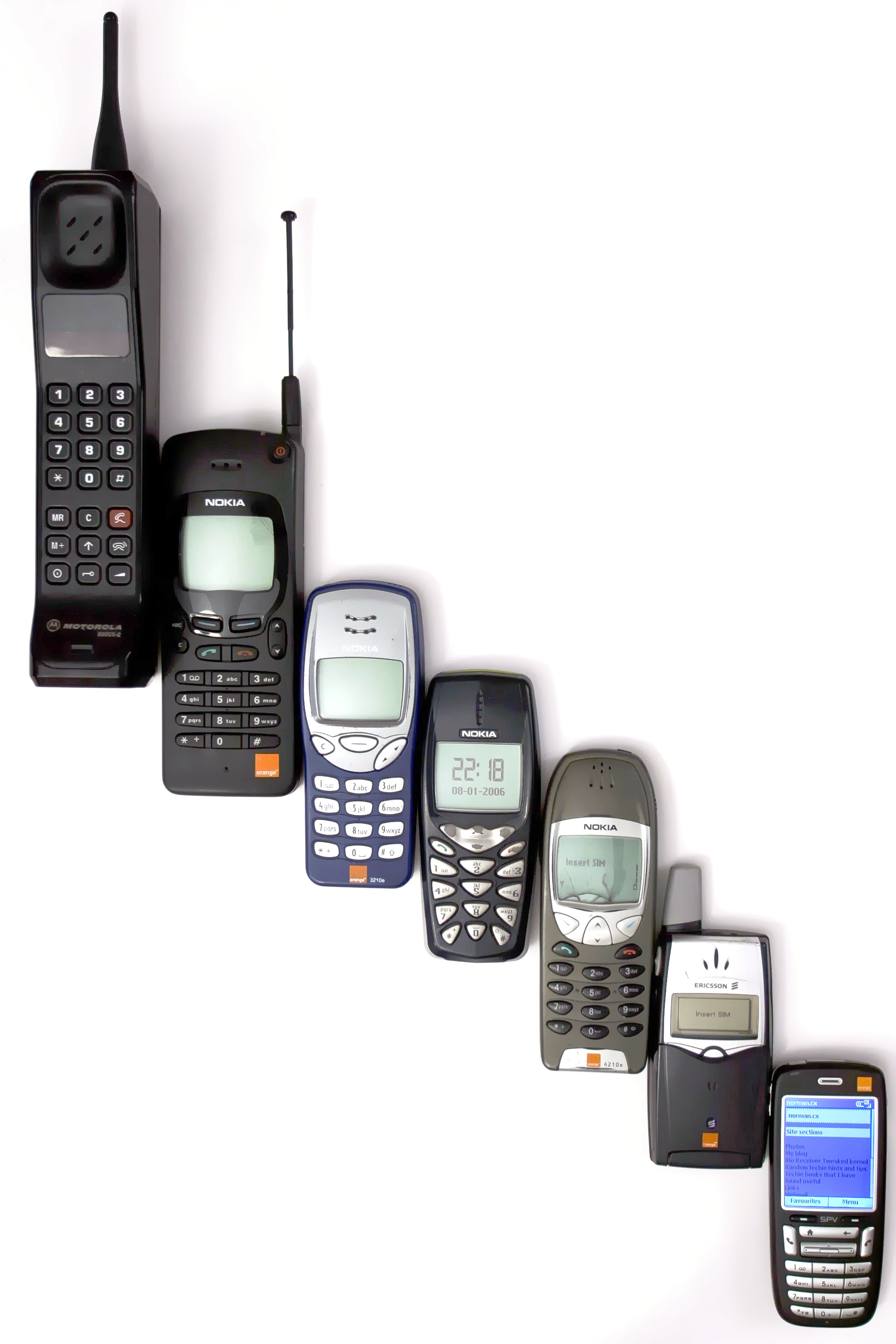
Radiophones have a long and varied history going back to Reginald Fessenden's invention and shore-to-ship demonstration of radio telephony, through the Second World War with military use of radio telephony links and civil services in the 1950s.
The first mobile telephone call made from a car occurred in St. Louis, Missouri, USA on June 17, 1946, using the Bell System's Mobile Telephone Service, but the system was impractical from what is considered a portable handset today. The equipment weighed 80 pounds (36 kg), and the AT&T service, basically a massive party line, cost US$30 per month (equal to $337.33 today) plus 30–40 cents per local call, equal to $3.37 to $4.5 today.[6]
In 1956, the world’s first partly automatic car phone system, Mobile System A (MTA), was launched in Sweden. MTA phones were composed of vacuum tubes and relays, and had a weight of 40 kg. In 1962, a more modern version called Mobile System B (MTB) was launched, which was a push-button telephone, and which used transistors to enhance the telephone’s calling capacity and improve its operational reliability, thereby reducing the weight of the apparatus to 10 kg. In 1971, the MTD version was launched, opening for several different brands of equipment and gaining commercial success.[7][8]


Early phones were not mobile
Martin Cooper, a Motorola researcher and executive is considered to be the inventor of the first practical mobile phone for handheld use in a non-vehicle setting, after a long race against Bell Labs for the first portable mobile phone. Using a modern, if somewhat heavy portable handset, Cooper made the first call on a handheld mobile phone on April 3, 1973 to his rival, Dr. Joel S. Engel of Bell Labs.[9]
The first commercially automated cellular network (the 1G) was launched in Japan by NTT in 1979, initially in the metropolitan area of Tokyo. Within five years, the NTT network had been expanded to cover the whole population of Japan and became the first nationwide 1G network. In 1981, this was followed by the simultaneous launch of the Nordic Mobile Telephone (NMT) system in Denmark, Finland, Norway and Sweden.[10] NMT was the first mobile phone network featuring international roaming. The first 1G network launched in the USA was Chicago-based Ameritech in 1983 using the Motorola DynaTAC mobile phone. Several countries then followed in the early-to-mid 1980s including the UK, Mexico and Canada.
The first "modern" network technology on digital 2G (second generation) cellular technology was launched by Radiolinja (now part of Elisa Group) in 1991 in Finland on the GSM standard, which also marked the introduction of competition in mobile telecoms when Radiolinja challenged incumbent Telecom Finland (now part of TeliaSonera) who ran a 1G NMT network.
In 2001, the first commercial launch of 3G (Third Generation) was again in Japan by NTT DoCoMo on the WCDMA standard.[11]
One of the newest 3G technologies to be implemented is High-Speed Downlink Packet Access (HSDPA). It is an enhanced 3G (third generation) mobile telephony communications protocol in the high-speed packet access (HSPA) family, also coined 3.5G, 3G+ or turbo 3G, which allows networks based on Universal Mobile Telecommunications System (UMTS) to have higher data transfer speeds and capacity.
Features

A printed circuit board inside a Nokia 3210

All mobile phones have a number of features in common, but manufacturers also try to differentiate their own products by implementing additional functions to make them more attractive to consumers. This has led to great innovation in mobile phone development over the past 20 years.
The common components found on all phones are:
- A battery, typically rechargeable, providing the power source for the phone functions
- An input mechanism to allow the user to interact with the phone. The most common input mechanism is a keypad, but touch screens are also found in some high-end smartphones.
- Basic mobile phone services to allow users to make calls and send text messages.
- All GSM phones use a SIM card to allow an account to be swapped among devices. Some CDMA devices also have a similar card called a R-UIM.
- Individual GSM, WCDMA, iDEN and some satellite phone devices are uniquely identified by an International Mobile Equipment Identity (IMEI) number.
Low-end mobile phones are often referred to as feature phones, and offer basic telephony, as well as functions such as playing music and taking photos, and sometimes simple applications based on generic managed platforms such as Java ME or BREW. Handsets with more advanced computing ability through the use of native software applications became known as smartphones. The first smartphone was the Nokia 9000 Communicator in 1996 which added PDA functionality to the basic mobile phone at the time. As miniaturization and increased processing power of microchips has enabled ever more features to be added to phones, the concept of the smartphone has evolved, and what was a high-end smartphone five years ago, is a standard phone today.
Several phone series have been introduced to address a given market segment, such as the RIM BlackBerry focusing on enterprise/corporate customer email needs; the SonyEricsson Walkman series of musicphones and Cybershot series of cameraphones; the Nokia Nseries of multimedia phones, the Palm Pre the HTC Dream and the Apple iPhone.
Other features that may be found on mobile phones include GPS navigation, music (MP3) and video (MP4) playback, RDS radio receiver, alarms, memo recording, personal digital assistant functions, ability to watch streaming video, video download, video calling, built-in cameras (1.0+ Mpx) and camcorders (video recording), with autofocus and flash, ringtones, games, PTT, memory card reader (SD), USB (2.0), dual line support, infrared, Bluetooth (2.0) and WiFi connectivity, instant messaging, Internet e-mail and browsing and serving as a wireless modem. Nokia and the University of Cambridge demonstrated a bendable cell phone called the Morph.[12] Some phones can make mobile payments via direct mobile billing schemes or through contactless payments if the phone and point of sale support Near Field Communication (NFC).[13] Some of the largest mobile phone manufacturers and network providers along with many retail merchants support, or plan to support, contactless payments through NFC-equipped mobile phones.[14][15][16]
Software and applications


A Toshiba TG01 phone with touchscreen feature
The most commonly used data application on mobile phones is SMS text messaging. The first SMS text message was sent from a computer to a mobile phone in 1992 in the UK, while the first person-to-person SMS from phone to phone was sent in Finland in 1993.
Other non-SMS data services used on mobile phones include mobile music, downloadable logos and pictures, gaming, gambling, adult entertainment and advertising. The first downloadable mobile content was sold to a mobile phone in Finland in 1998, when Radiolinja (now Elisa) introduced the downloadable ringtone service. In 1999, Japanese mobile operator NTT DoCoMo introduced its mobile Internet service, i-Mode, which today is the world's largest mobile Internet service.
The first mobile news service, delivered via SMS, was launched in Finland in 2000. Mobile news services are expanding with many organizations providing "on-demand" news services by SMS. Some also provide "instant" news pushed out by SMS.
Mobile payments were first trialled in Finland in 1998 when two Coca-Cola vending machines in Espoo were enabled to work with SMS payments. Eventually, the idea spread and in 1999 the Philippines launched the first commercial mobile payments systems, on the mobile operators Globe and Smart. Today, mobile payments ranging from mobile banking to mobile credit cards to mobile commerce are very widely used in Asia and Africa, and in selected European markets.
Power supply


Mobile phones generally obtain power from rechargeable batteries. There are a variety of ways used to charge cell phones, including USB, portable batteries, mains power (using an AC adapter), cigarette lighters (using an adapter), or a dynamo. In 2009, the first wireless charger was released for consumer use.[17]
Development and adoption of a common charger solution
On 17 February 2009, the GSM Association (GSMA), together with 17 mobile phone manufacturers and providers, announced[18] their commitment to implementing a cross-industry standard for a universal charging solution for new mobile phones. The standard charger connector to be adopted by manufacturers in the Open Mobile Terminal Platform (OMTP) including Nokia, Motorola and Samsung is the micro-USB connector (several media reports erroneously reported this as the mini-USB). The new chargers will also be much more energy efficient than existing chargers. Having a standard charger for all phones means that manufacturers will no longer have to supply a charger with every new phone. The OMTP technical requirements describe a common charger with a standard USB-A receptacle and a detachable USB-A to microUSB-B cable.[19][20]
In October 2009, the International Telecommunication Union (ITU) announced that it had also embraced the Universal Charging Solution standard – based on the OMTP specifications promoted by the GSMA – as its "energy-efficient one-charger-fits-all new mobile phone solution," and added: "Based on the Micro-USB interface, UCS chargers will also include a 4-star or higher efficiency rating — up to three times more energy-efficient than an unrated charger."[21]
Common power supply standard in the European Union
Main article: common External Power Supply
In 2009, many mobile phone manufacturers signed a Memorandum of Understanding (MoU), agreeing to make most new data-enabled cell phones marketed in the EU compatible with a common External Power Supply (EPS). All signatories agreed to develop a common specification for the charger "to allow for full compatibility and safety of chargers and mobile phones."[22][23] The technical specifications for the common EPS were published in December 2010 as EN 62684:2010, “Interoperability specifications of common external power supply (EPS) for use with data-enabled mobile telephones."[24] The mobile phone manufacturers who have agreed to this standard include the original signatories Apple, LG, Motorola, NEC, Nokia, Qualcomm, RIM, Samsung, Sony Ericsson, and Texas Instruments as well as Atmel, Emblaze Mobile, Huawei Technologies and TCT Mobile (Alcatel).[25] The Memorandum of Understanding also provides for the use of the common External Power Supply with compliant phones not equipped with a MicroUSB receptacle: "4.2.1 ... if a manufacturer makes available an Adaptor from the Micro-USB connector of a Common EPS [External Power Supply] to a specific non-Micro-USB socket in the Mobile Phone, it shall constitute compliance to this article."
Common power supply standard in the People's Republic of China
In 2006, the People's Republic of China issued a standard for mobile device power supplies (based on a 5V Power Supply with a USB-A receptacle and a detachable cable). The 2006 regulation is flexible regarding the interface on the mobile phone itself, allowing for the use of adapter cables if the mobile device is not equipped with a standard USB connector.[26] The standard was revised in December, 2009 (CCSA YD/T 1591–2006 updated to YD/T 1591–2009).
Common power supply standard in South Korea
In 2001, the South Korean Telecommunications Technology Association (TTA) released a "Standard on I/O Connection Interface of Digital Cellular Phone" TTAS.KO-06.0028.[27] The main feature of the standard is the specification of a 24 pin connector / socket for mobile phones sold in Korea. The 24 pin connector handles power input (battery charging) and power output, as well as data communication (USB and other digital signals), analog audio inputs and outputs (for hands-free microphone, earphone) and other signals. The 2007 revision of the standard (TTAS.KO-06.0028/R4) specifies a smaller 20 pin connector to succeed the 24 pin connector.[28]
Charger efficiency


The world's five largest handset makers introduced a new rating system in November 2008 to help consumers more easily identify the most energy-efficient chargers
The majority of energy lost in a mobile phone charger is in its no load condition, when the mobile phone is not connected but the charger has been left plugged in and using power. To combat this, in November 2008, the top five mobile phone manufacturers Nokia, Samsung, LG, Sony Ericsson, and Motorola set up a star rating system to rate the efficiency of their chargers in the no-load condition. Starting at zero stars for >0.5 W and going up to the top five star rating for <0.03 W (30 mW) no load power.[29]
A number of semiconductor companies offering flyback controllers, such as Power Integrations and CamSemi, now claim that the five-star standard can be achieved with use of their product.[30]
Battery
Formerly, the most common form of mobile phone batteries were nickel metal-hydride, as they have a low size and weight. Lithium ion batteries are sometimes used, as they are lighter and do not have the voltage depression that nickel metal-hydride batteries do. Many mobile phone manufacturers have now switched to using lithium–polymer batteries as opposed to the older Lithium-Ion, the main advantages of this being even lower weight and the possibility to make the battery a shape other than strict cuboid.[31] Mobile phone manufacturers have been experimenting with alternative power sources, including solar cells. A prototype mini solar panel from Wysips was able use perfectly as 'live phone' with Android phone. The mini solar panel can be installed on the Android phone screen, although the phone battery is still needed due to the solar panel solely has not been able to produce enough energy.[32]
SIM card


Typical mobile phone SIM card
GSM mobile phones require a small microchip called a Subscriber Identity Module or SIM Card, to function. The SIM card is approximately the size of a small postage stamp and is usually placed underneath the battery in the rear of the unit. The SIM securely stores the service-subscriber key (IMSI) used to identify a subscriber on mobile telephony devices (such as mobile phones and computers). The SIM card allows users to change phones by simply removing the SIM card from one mobile phone and inserting it into another mobile phone or broadband telephony device.
A SIM card contains its unique serial number, internationally unique number of the mobile user (IMSI), security authentication and ciphering information, temporary information related to the local network, a list of the services the user has access to and two passwords (PIN for usual use and PUK for unlocking).
SIM cards are available in three standard sizes. The first is the size of a credit card (85.60 mm × 53.98 mm x 0.76 mm). The newer, most popular miniature version has the same thickness but a length of 25 mm and a width of 15 mm, and has one of its corners truncated (chamfered) to prevent misinsertion. The newest incarnation known as the 3FF or micro-SIM has dimensions of 15 mm × 12 mm. Most cards of the two smaller sizes are supplied as a full-sized card with the smaller card held in place by a few plastic links; it can easily be broken off to be used in a device that uses the smaller SIM.
The first SIM card was made in 1991 by Munich smart card maker Giesecke & Devrient for the Finnish wireless network operator Radiolinja. Giesecke & Devrient sold the first 300 SIM cards to Elisa (ex. Radiolinja).
Those cell phones that do not use a SIM Card have the data programmed in to their memory. This data is accessed by using a special digit sequence to access the "NAM" as in "Name" or number programming menu. From there, information can be added, including a new number for the phone, new Service Provider numbers, new emergency numbers, new Authentication Key or A-Key code, and a Preferred Roaming List or PRL. However, to prevent the phone being accidentally disabled or removed from the network, the Service Provider typically locks this data with a Master Subsidiary Lock (MSL). The MSL also locks the device to a particular carrier when it is sold as a loss leader.
The MSL applies only to the SIM, so once the contract has expired, the MSL still applies to the SIM. The phone, however, is also initially locked by the manufacturer into the Service Provider's MSL. This lock may be disabled so that the phone can use other Service Providers' SIM cards. Most phones purchased outside the U.S. are unlocked phones because there are numerous Service Providers that are close to one another or have overlapping coverage. The cost to unlock a phone varies but is usually very cheap and is sometimes provided by independent phone vendors.
A similar module called a Removable User Identity Module or RUIM card is present in some CDMA networks, notably in China and Indonesia.
Multi-card hybrid phones
A hybrid mobile phone can take more than one SIM card, even of different types. The SIM and RUIM cards can be mixed together, and some phones also support three or four SIMs[33][34]
From 2010 onwards they became popular in India and Indonesia and other emerging markets,[35] attributed to the desire to obtain the lowest on-net calling rate.
Display
Virtually all mobile phones have an integrated display device, some with touchscreen function. The main measurements for screen size varies greatly by model.
Manufacturers use different methods to specify display size, usually width and height in pixels or the diagonal measured in inches.
In 2011, a 3G Android Smartphone was launched with dual 3.5 inch screens. Furthermore, the screens can be combined into a single 4.7 inch which turns it into a Tablet computer. It uses a single Snapdragon processor.[36]
Central processing unit
Mobile phones have central processing units (CPUs), similar to those in computers, but optimised to operate in low power environments.
Mobile CPU performance depends not only on the clock rate (generally given in multiples of hertz) [37] but also the memory hierarchy also greatly affects overall performance. Because of these problems, the performance of mobile phone CPUs is often more appropriately given by scores derived from various standardized tests to measure the real effective performance in commonly used applications.
Mobile phones in society
Market share
| Quantity Market Shares by Gartner (New Sales) | ||||
| BRAND | Percent | |||
| Nokia 2009 | | 36.4% | ||
| Nokia 2010 | | 28.9% | ||
| Samsung 2009 | | 19.5% | ||
| Samsung 2010 | | 17.6% | ||
| LG Electronics 2009 | | 10.1% | ||
| LG Electronics 2010 | | 7.1% | ||
| Research In Motion 2009 | | 2.8% | ||
| Research In Motion 2010 | | 3.0% | ||
| Apple 2009 | | 2.1% | ||
| Apple 2010 | | 2.9% | ||
| Others-1 2009 | | 12.6% | ||
| Others-1 2010 | | 9.8% | ||
| Others-2 2009 | | 16.5% | ||
| Others-2 2010 | | 30.6% | ||


The world's largest individual mobile operator by subscribers is China Mobile with over 500 million mobile phone subscribers.[38] Over 50 mobile operators have over 10 million subscribers each, and over 150 mobile operators have at least one million subscribers by the end of 2009 (source wireless intelligence). In February 2010, there were 4.6 billion mobile phone subscribers, a number that is estimated to grow.[39]
Competitive forces emerged in the Asia Pacific (excluding Japan) region at Q3 2010 to the detriment of market leader Nokia. Brands such as Micromax, Nexian, and i-Mobile chipped away at Nokia's market share plus Android powered smartphones also gained momentum across the region at the cost of Nokia.
Based on IDC India, Nokia's market share dropped significantly to 36 percent in the second quarter, from 56.8 percent in the same quarter last year and further drop to 31.5 percent in the third quarter, reflecting the growing share of Chinese and Indian vendors of low-end mobile phones.[40]
Based on IDC in the last quarter of 2010, RIM has been knocked out from the top five list global mobile phone sellers. The number one rank is still Nokia followed by Samsung, LG Electronics, ZTE and Apple. For the first time Chinese ZTE is among the top five list and mainly make of lower cost phones.[41]
For the year of 2010, Sony Ericsson and Motorola are out from the top of five list and have been replaced by LG Electronics and Apple. Significant increase from 16.5 percent to 30.6 percent has been done by many small not yet recognized brands (some of them are new brands) – Others-2. Total sales in 2010 to end users were 1.6 billion units or increase by 31.8 percent from the year of 2009.[42]
At April 6, 2011 market capitalization of HTC surpassed Nokia with $33.8 billion over $33.4 billion respectively. The credit agency was also downgraded Nokia's debt from A2 to A3.[43]
Top Five Mobile Phone Market Share
| Source | Date | Others | References | |||||
| Q1/2011 | 29.2% | 18.8% | 6.6% | 5.0% | 4.1% | 36.3% |
- Source: IDC Worlwide Mobile Phone Trackers, April 28, 2011
- Note: Vendor shipments are branded shipments and exclude OEM sales for all vendors
By year-over-year at Q1, Nokia dropped significantly, but Apple rose significantly, while Others still rose and achieved more than a third of market share. Vendors shipped 371.8 million units in Q1 2011 compared to 310.5 million units in Q1 2010 or growing by 19.8 percent.
Other manufacturers include Audiovox (now UTStarcom), CECT, HTC Corporation, Fujitsu, Kyocera, Mitsubishi Electric, NEC, Panasonic, Palm, Pantech Wireless Inc., Philips, Qualcomm Inc., Research In Motion Ltd. (RIM), Sagem, Sanyo, Sharp, Sierra Wireless, Just5, SK Teletech, T&A Alcatel, Huawei, Trium, Toshiba and Vidalco. There are also specialist communication systems related to (but distinct from) mobile phones.
Media
In 1998, one of the first examples of selling media content through the mobile phone was the sale of ringtones by Radiolinja in Finland. Soon afterwards, other media content appeared such as news, videogames, jokes, horoscopes, TV content and advertising. Most early content for mobile tended to be copies of legacy media, such as the banner advertisement or the TV news highlight video clip. Recently, unique content for mobile has been emerging, from the ringing tones and ringback tones in music to "mobisodes," video content that has been produced exclusively for mobile phones.
In 2006, the total value of mobile-phone-paid media content exceeded Internet-paid media content and was worth 31 billion dollars (source Informa 2007). The value of music on phones was worth 9.3 billion dollars in 2007 and gaming was worth over 5 billion dollars in 2007.[45]
The advent of media on the mobile phone has also produced the opportunity to identify and track Alpha Users or Hubs, the most influential members of any social community. AMF Ventures measured in 2007 the relative accuracy of three mass media, and found that audience measures on mobile were nine times more accurate than on the Internet and 90 times more accurate than on TV.[original research?]
The mobile phone is often called the Fourth Screen (if counting cinema, TV and PC screens as the first three) or Third Screen (counting only TV and PC screens).[weasel words] It is also called the Seventh of the Mass Media (with Print, Recordings, Cinema, Radio, TV and Internet the first six).
Privacy
Main article: Mobile phone tracking
The movements of a mobile phone user can be tracked by their service provider and, if desired, by law enforcement agencies and their government. Both the SIM card and the handset can be tracked.[46] China has proposed using this technology to track commuting patterns of Beijing city residents.[47]
Usage
Examples
Mobile phones are used for a variety of purposes, including keeping in touch with family members, conducting business, and having access to a telephone in the event of an emergency. Some people carry more than one cell phone for different purposes, such as for business and personal use. Multiple SIM cards may also be used to take advantage of the benefits of different calling plans—a particular plan might provide cheaper local calls, long-distance calls, international calls, or roaming. A study by Motorola found that one in ten cell phone subscribers have a second phone that often is kept secret from other family members. These phones may be used to engage in activities including extramarital affairs or clandestine business dealings.[48] The mobile phone has also been used in a variety of diverse contexts in society, for example:
- Organizations that aid victims of domestic violence may offer a cell phone to potential victims without the abuser's knowledge. These devices are often old phones that are donated and refurbished to meet the victim's emergency needs.[49]
- Child predators have taken advantage of cell phones to communicate secretly with children without the knowledge of their parents or teachers.[50]
- The advent of widespread text messaging has resulted in the cell phone novel; the first literary genre to emerge from the cellular age via text messaging to a website that collects the novels as a whole.[51] Paul Levinson, in Information on the Move (2004), says "...nowadays, a writer can write just about as easily, anywhere, as a reader can read" and they are "not only personal but portable."
- Mobile telephony also facilitates activism and public journalism being explored by Reuters and Yahoo![52] and small independent news companies such as Jasmine News in Sri Lanka.
- Mobile phones help lift poor out of poverty. The United Nations has reported that mobile phones—spreading faster than any other information technology—can improve the livelihood of the poorest people in developing countries. The economic benefits of mobile phones go well beyond access to information where a landline or Internet is not yet available in rural areas, mostly in Least Developed Countries. Mobile phones have spawned a wealth of micro-enterprises, offering work to people with little education and few resources, such as selling airtime on the streets and repairing or refurbishing handsets.[53]
- In Mali and some African countries, villagers sometimes had to go from village to village all day, covering up to 20 villages, to let friends and relatives know about a wedding, a birth or a death, but such travel is no longer necessary if the villages are within the coverage area of a mobile phone network. Like in many African countries, the coverage is better than that of landline networks, and most people own a mobile phone. However, small villages have no electricity, leaving mobile phone owners to have to recharge their phone batteries using a solar panel or motorcycle battery.[54]
- The TV industry has recently started using mobile phones to drive live TV viewing through mobile apps, advertising, social tv, and mobile TV.[55] 86% of Americans use their mobile phone while watching TV.
- In March 2011, a pilot project experimenting with branchless banking was launched by the International Finance Corporation, a member of the World Bank, and Bank Harapan Bali, a subsidiary of Bank Mandiri—the biggest bank in Indonesia and one of the cellular operators in Bali. Its aim is to increase the amount of bank customers. In Indonesia, only 60 million people have a bank account even though banks have existed for more than a hundred years, whereas 114 million people have become users of mobile phones in only two decades. Branchless banking has been successful in Kenya, South Africa and Philippines.[56]
Sharing
In some parts of the world, mobile phone sharing is common. It is prevalent in urban India, as families and groups of friends often share one or more mobiles among their members. There are obvious economic benefits, but often familial customs and traditional gender roles play a part.[57] For example, in Burkina Faso, it is not uncommon for a village to have access to only one mobile phone. The phone is typically owned by a person who is not natively from the village, such as a teacher or missionary, but it is expected that other members of the village are allowed to use the cell phone to make necessary calls.[58]
Restrictions
While driving
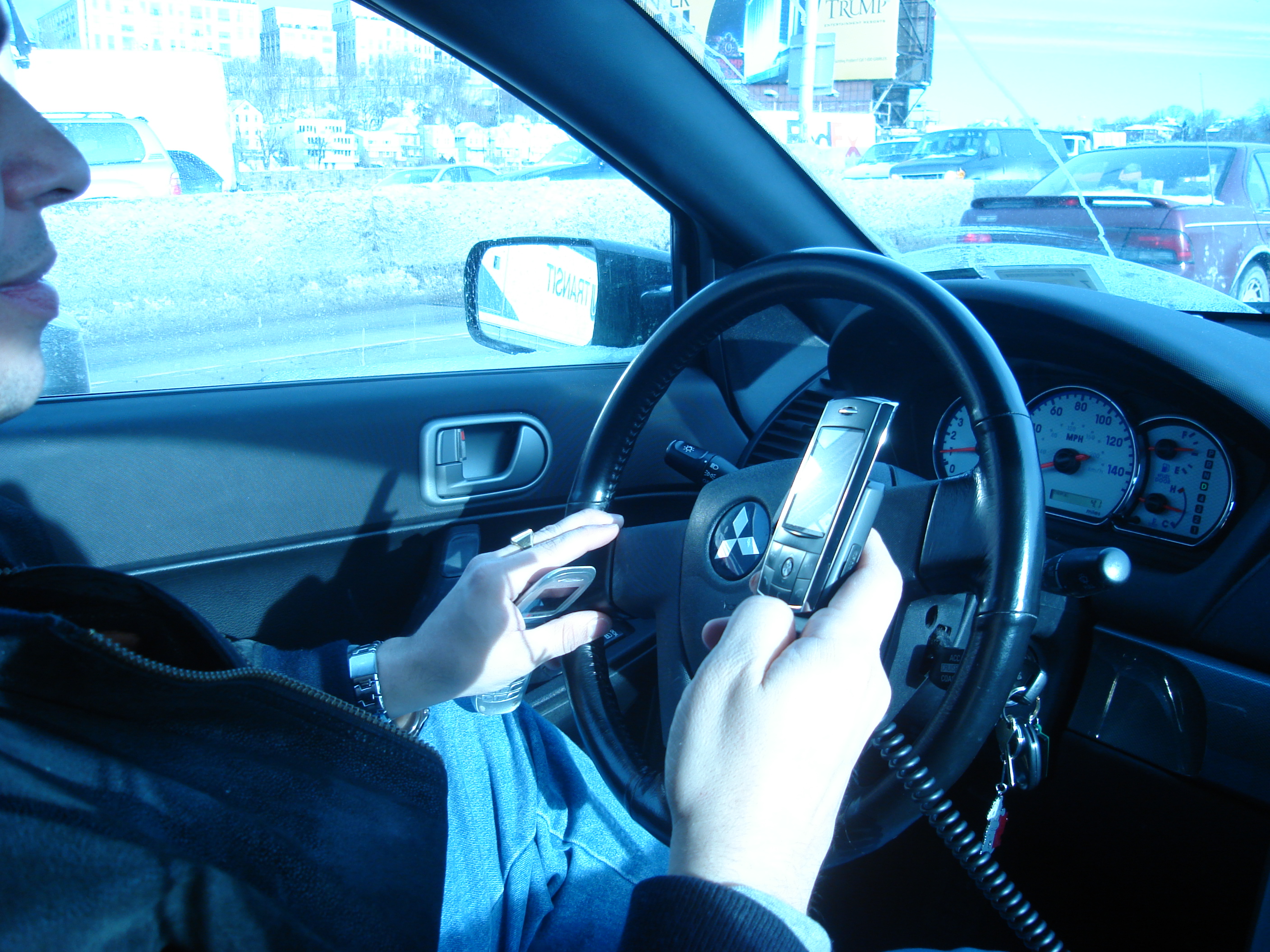

Mobile phone use while driving is common but controversial. Being distracted while operating a motor vehicle has been shown to increase the risk of accident. Because of this, many jurisdictions prohibit the use of mobile phones while driving. Egypt, Israel, Japan, Portugal and Singapore ban both handheld and hands-free use of a mobile phone whilst many other countries—including the UK, France, and many U.S. states—ban handheld phone use only, allowing hands-free use.
Due to the increasing complexity of mobile phones, they are often more like mobile computers in their available uses. This has introduced additional difficulties for law enforcement officials in distinguishing one usage from another as drivers use their devices. This is more apparent in those countries which ban both handheld and hands-free usage, rather those who have banned handheld use only, as officials cannot easily tell which function of the mobile phone is being used simply by visually looking at the driver. This can lead to drivers being stopped for using their device illegally on a phone call when, in fact, they were using the device for a legal purpose such as the phone's incorporated controls for car stereo or satnav.
A recently published study has reviewed the incidence of mobile phone use while cycling and its effects on behaviour and safety.[59]
In schools
Some schools limit or restrict the use of mobile phones. Schools set restrictions on the use of mobile phones because of the use of cell phones for cheating on tests, harassment and bullying, causing threats to the schools security, distractions to the students, and facilitating gossip and other social activity in school. Many mobile phones are banned in school locker room facilities, public restrooms and swimming pools due to the built-in cameras that most phones now feature.
Privacy
Mobile phones have numerous privacy issues.
Governments, law enforcement and intelligence services use mobiles to perform surveillance in the UK and the US They possess technology to activate the microphones in cell phones remotely in order to listen to conversations that take place near to the person who holds the phone.[60][61]
Mobile phones are also commonly used to collect location data. While the phone is turned on, the geographical location of a mobile phone can be determined easily (whether it is being used or not), using a technique known multilateration to calculate the differences in time for a signal to travel from the cell phone to each of several cell towers near the owner of the phone.[62][63]
Health effects
There exists a community that believes mobile phone use represents a long-term health risk, a belief which is currently confirmed by the World Health Organization, which lists cell phone use a possible carcinogen.[64][65] The WHO released a report on 31 May 2011[4] classifying cell phone radiation as a "carcinogenic hazard" and "possibly carcinogenic to humans." It was classified as such after a team of scientists reviewed peer-review studies on cell phone safety.[5] One study of past cell phone use cited in the report showed a "40% increased risk for gliomas in the highest category of heavy users (reported average: 30 minutes per day over a 10‐year period)."[66] (This is a reversal from their prior position that cancer was unlikely to be caused by cellular phones or their base stations and that reviews had found no convincing evidence for other health effects.[65][67]) Certain countries, including France, have warned against the use of cell phones especially by minors due to health risk uncertainties.[68]
The effect mobile phone radiation has on human health is the subject of recent interest and study, as a result of the enormous increase in mobile phone usage throughout the world (as of June 2009, there were more than 4.3 billion users worldwide[69]). Mobile phones use electromagnetic radiation in the microwave range, which some believe may be harmful to human health. A large body of research exists, both epidemiological and experimental, in non-human animals and in humans, of which the majority shows no definite causative relationship between exposure to mobile phones and harmful biological effects in humans. This is often paraphrased simply as the balance of evidence showing no harm to humans from mobile phones, although a significant number of individual studies do suggest such a relationship, or are inconclusive. Other digital wireless systems, such as data communication networks, produce similar radiation.
At least some recent studies have found an association between cell phone use and certain kinds of brain and salivary gland tumors. Lennart Hardell and other authors of a 2009 meta-analysis of 11 studies from peer-reviewed journals concluded that cell phone usage for at least ten years “approximately doubles the risk of being diagnosed with a brain tumor on the same ("ipsilateral") side of the head as that preferred for cell phone use.”[70]
Future evolution: Broadband Fourth generation (4G)
The recently released 4th generation, also known as Beyond 3G, aims to provide broadband wireless access with nominal data rates of 100 Mbit/s to fast moving devices, and 1 Gbit/s to stationary devices defined by the ITU-R[71] 4G systems may be based on the 3GPP LTE (Long Term Evolution) cellular standard, offering peak bit rates of 326.4 Mbit/s. It may perhaps also be based on WiMax or Flash-OFDM wireless metropolitan area network technologies that promise broadband wireless access with speeds that reaches 233 Mbit/s for mobile users. The radio interface in these systems is based on all-IP packet switching, MIMO diversity, multi-carrier modulation schemes, Dynamic Channel Assignment (DCA) and channel-dependent scheduling. A 4G system should be a complete replacement for current network infrastructure and is expected to be able to provide a comprehensive and secure IP solution where voice, data, and streamed multimedia can be given to users on a "Anytime, Anywhere" basis, and at much higher data rates than previous generations. Sprint in the US has claimed its WiMax network to be "4G network" which most cellular telecoms standardization experts dispute repeatedly around the world. Sprint's 4G is seen as a marketing gimmick as WiMax itself is part of the 3G air interface. The officially accepted, ITU ratified standards-based 4G networks are not expected to be commercially launched until 2011. In March 2011, KT (telecommunication company) from South Korea announced that they has expanded its high-speed wireless broadband network by 4G WiBro cover 85 percent of the population. It is the largest broadband network covered in the world, followed by Japan and US with 70 percent and 36 percent respectively.[72] At the beginning of 2011, some major mobile phone companies have released their 4G mobile phones such as from Motorola, HTC and Samsung.[73]
Comparison to similar systems
A type of telephone permanently mounted in a vehicle, these often have more powerful transmitters, an external antenna and loudspeaker for hands free use. They usually connect to the same networks as regular mobile phones.
Cordless telephone (portable phone)
Cordless phones are telephones which use one or more radio handsets in place of a wired handset. The handsets connect wirelessly to a base station, which in turn connects to a conventional land-line for calling. Unlike mobile phones, cordless phones use private base stations (belonging to the land-line subscriber), which are not shared.
Advanced professional mobile radio systems can be very similar to mobile phone systems. Notably, the IDEN standard has been used as both a private trunked radio system as well as the technology for several large public providers. Similar attempts have even been made to use TETRA, the European digital PMR standard, to implement public mobile networks.
This is a term which covers radios which could connect into the telephone network. These phones may not be mobile; for example, they may require a mains power supply, or they may require the assistance of a human operator to set up a PSTN phone call.
This type of phone communicates directly with an artificial satellite, which in turn relays calls to a base station or another satellite phone. A single satellite can provide coverage to a much greater area than terrestrial base stations. Since satellite phones are costly, their use is typically limited to people in remote areas where no mobile phone coverage exists, such as mountain climbers, mariners in the open sea, and news reporters at disaster sites.
This type of phone delivers or receives calls over internet, LAN or WAN networks using VoIP as opposed to traditional CDMA and GSM networks. In business, the majority of these IP Phones tend to be connected via wired Ethernet, however wireless varieties do exist. Several vendors have developed standalone WiFi phones. Additionally, some cellular mobile phones include the ability to place VoIP calls over cellular high speed data networks and/or wireless internet.[74]
Alternate Names for mobile phones
Mag-subscribe sa:
Mga Komento (Atom)